
.png)
.png)
America's first junkfood, Cracker Jack

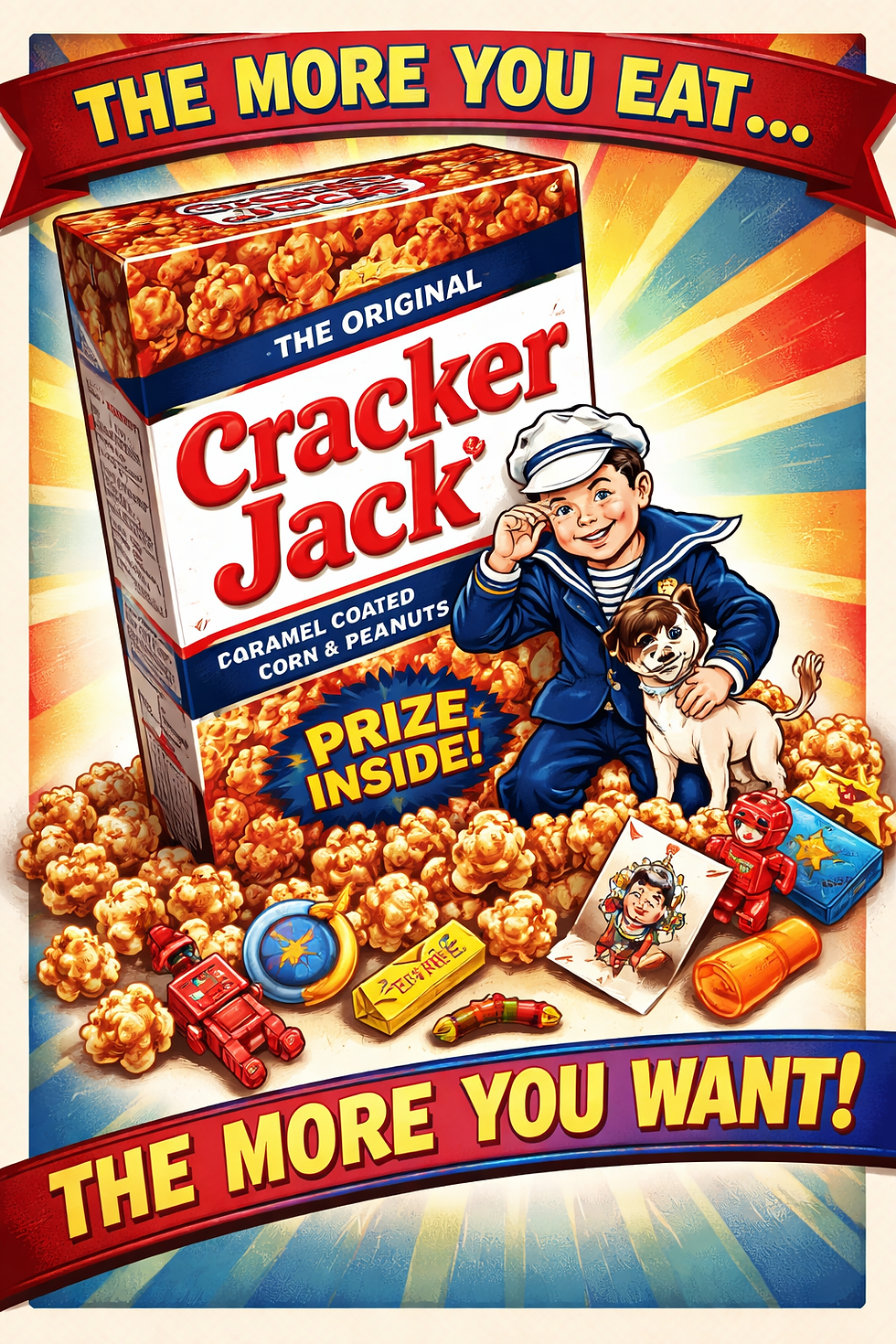
Cracker Jack is often hailed as America’s first true junk food, a caramel-coated mix of popcorn and peanuts that became not just a snack, but a cultural touchstone. Born in Chicago in the late 19th century, it bridged nostalgia, baseball, and the rise of mass consumerism, securing its place in the American imagination.
Origins at the Chicago World’s Fair
Cracker Jack made its debut in 1893 at the World's Columbian Exposition, created by German immigrant Frederick Rueckheim. His key innovation was deceptively simple: a caramel coating that didn’t leave fingers hopelessly sticky. That small breakthrough elevated it above the typical fairground popcorn.
The name itself came from slang of the era. After tasting it, someone reportedly exclaimed, “That’s a crackerjack!”—meaning “excellent” or “top-notch.” The Rueckheim brothers knew a good thing when they heard it. By 1896, the brand was officially registered with the irresistible slogan: “The More You Eat, The More You Want.”
Baseball & National Fame
Cracker Jack’s legacy became inseparable from America’s pastime thanks to the 1908 song Take Me Out to the Ball Game. With the immortal line, “Buy me some peanuts and Cracker Jack,” the snack was woven into the very fabric of baseball culture. From that moment on, it wasn’t just food—it was ritual. Ballparks, bleachers, summer heat, and the satisfying crunch of caramel popcorn became a shared national experience.
The Prize Inside
In 1912, Cracker Jack introduced the surprise prize in every box, a marketing stroke of genius that transformed snacking into an event. Over time, more than 23 billion prizes were distributed, ranging from paper puzzles to tiny toys.
When Frito-Lay acquired the brand in 1997, the tradition continued, though it evolved. In 2016, physical prizes were largely replaced by digital experiences via QR codes. Still, the idea of the prize remains central to Cracker Jack’s identity: the promise that something extra is waiting inside.
Junk Food Pioneer
Food historian Andrew F. Smith famously called Cracker Jack “the first junk food,” and the label fits. It introduced a formula that would define modern snacking: sweet, addictive flavor, portable packaging, and clever marketing, all with minimal nutritional value. Long before chips and fast food chains took over, Cracker Jack laid the groundwork.
The Ritual of the Prize
For generations of kids, opening a box of Cracker Jack wasn’t passive, it was an experience:
The Aroma: A rush of warm caramel sweetness
The Search: Fingers digging through kernels for hidden treasure
The Reveal: A sticker, a puzzle, a tiny toy
The Memory: That fleeting, magical moment of discovery
The prize transformed the snack into a miniature adventure, a cardboard box filled with anticipation.
From Snack to Slang — Cracker Jack in Pop Culture
Cracker Jack didn’t just influence taste buds—it shaped language. The phrase “Did you get that in a box of Cracker Jacks?” became a playful jab, suggesting something flashy or cheap looked like a toy prize. Its connection to baseball added a wink of nostalgia, and the brand leaned into the joke. The prizes weren’t just gimmicks, they were part of the charm.
Cultural Wink
That tiny prize envelope became iconic enough to enter the American lexicon. Saying something “came from a Cracker Jack box” instantly evokes childhood wonder mixed with kitschy delight, a shared cultural shorthand spanning generations.
Enter Cracker Jill: A Modern Twist on a Classic
In 2022, Cracker Jack introduced Cracker Jill, a limited-edition spin on the classic snack designed to celebrate women in sports—particularly in baseball. Timed with Opening Day, Cracker Jill featured five different female athlete mascots, each representing different backgrounds and roles within the game. It wasn’t just a packaging change, it was a statement.
Where the original sailor mascot, Sailor Jack, symbolized early 20th-century Americana, Cracker Jill reflected a broader, more inclusive vision of who belongs in the stands—and on the field. Even more meaningful, proceeds from Cracker Jill sales supported the Women’s Sports Foundation, reinforcing its mission beyond marketing. Cracker Jill didn’t replace the original, it complemented it, proving that even the most nostalgic brands can evolve while honoring their roots.
Conclusion
Cracker Jack began as a simple mix of caramel-coated popcorn and peanuts, but it became something far greater: a ritual, a lyric in a beloved song, a cultural reference point, and a shared memory. From paper puzzles to digital surprisesand now to Cracker Jill’s modern reimagining, the brand continues to adapt while preserving its core magic: the joy of discovery. Because in the end, Cracker Jack was never just about the snack. It was about the moment before you found the prize. My favorite was always the rub-on tatoos, pure playground currency. What about you, what Cracker Jack (or Cracker Jill) prize do you remember most?
Join us/Sign up/Catch our podcast
Every week, Whats Shakin With Shaner publishes a new blog/article on Wednesdays. Make sure you don't miss one and sign up today.
To catch our bi-weekly podcast, "What' Shakin With Shaner", you can find us on Apple podcasts, Spotify, Goodpods, Podcast Addict, Amazon Music, Audible, I Heart Radio or at our website, shakinshaner.com. We publish a new episode every other Sunday.


My Perfect Hotel is the calm, satisfying game my routine needed.
Ragdoll Hit stays hilarious even after I've played dozens of matches.
Level Devil is dangerously fun, I opened it for five minutes and looked up an hour later.